![[2026-08-05] 용인 반도체 클러스터 12년 조기화 좌담 — 360조 베팅과 미국 파운드리 속도전, 한국은 따라잡나](https://metaqsol.com/wp-content/uploads/2026/08/hero_ai-2.png)
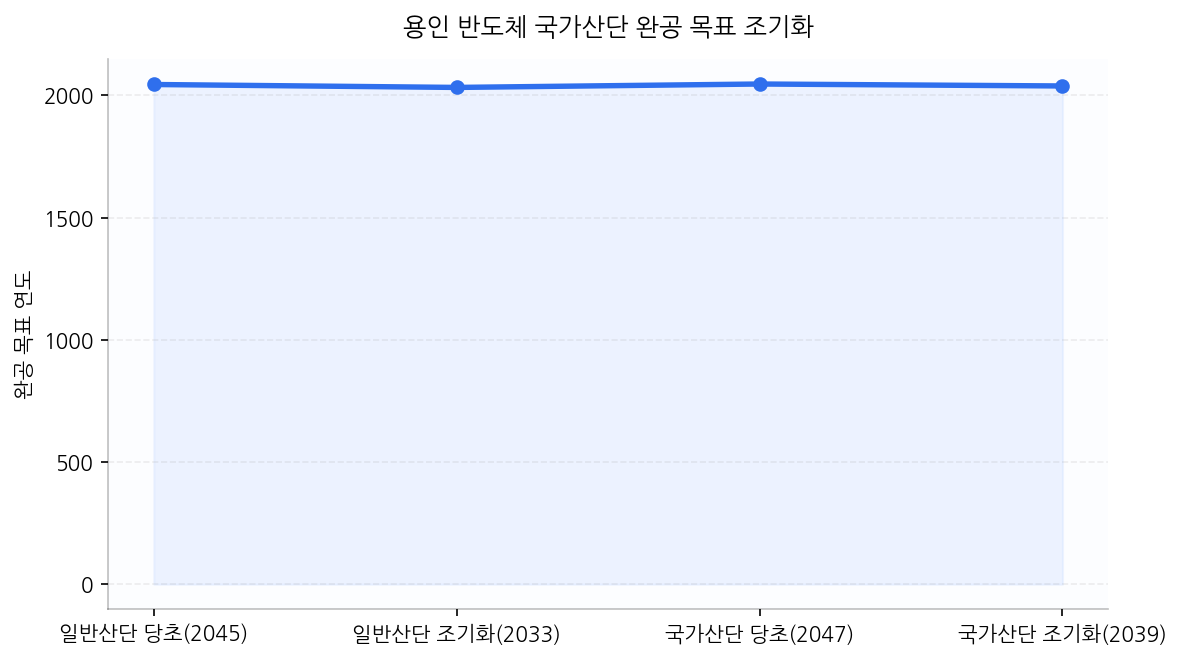
On August 4, 2026, South Korea’s Ministry of Trade, Industry and Energy (MOTIE) presented its second-half 2026 work plan to President Lee Jae-myung, built around three “mega-projects,” chief among them the Yongin semiconductor cluster. MOTIE said it would move up completion of the general industrial complex by 12 years (from 2045 to 2033) and the national industrial complex by 8 years (from 2047 to 2039), while ramping trade finance for strategic exports (defense, nuclear power, electricity) from 18 trillion won this year to 127 trillion won by 2030, part of a push toward becoming a top-5 exporter with $1 trillion in exports.
What was announced
The Yongin cluster, where Samsung Electronics and SK hynix are the anchor investors, was formally designated a national industrial complex on December 31, 2024. Land developer LH has since begun sending compensation notices to landowners, targeting groundbreaking before December 2026 and first fab operation by 2029–2030. Long-term private investment in the cluster is estimated at more than 360 trillion won (roughly $267 billion at 1,350 won/$). MOTIE says it will finish land compensation this year and secure power and water supply on an accelerated schedule to hit the new completion targets.
Why this policy matters for the United States
This announcement is directly relevant to the United States on two fronts. Korea’s semiconductor cluster timeline is now explicitly being measured against U.S.-based capacity: TSMC’s $165 billion Arizona expansion — the largest foreign direct investment in U.S. history — already has its first fab producing advanced chips for Apple and Nvidia as of March 2026, with a second fab’s equipment move-in targeted for Q3 2026, putting Korea in a direct multi-year race against chips that are already shipping out of Arizona. There’s also a shipbuilding and energy angle: MOTIE said it will select Korea’s “first strategic U.S. investment project” this year in one of those sectors, building on the Korea-U.S. Shipbuilding Cooperation Center that opened in the United States on July 23, 2026, and on a planned expansion of trade finance to 127 trillion won by 2030 covering defense, nuclear and power exports — all areas where U.S. industrial and energy policy has a direct stake.
A faster-moving comparison case: TSMC Arizona
TSMC’s Arizona buildout offers a useful yardstick. As of March 2026, the first Arizona fab is already in volume production for Apple and Nvidia, and the second fab has completed construction with equipment installation planned for the third quarter of 2026. By contrast, even Korea’s accelerated targets put Yongin’s general and national complexes at 2033 and 2039 completion respectively — meaning Korea’s “faster” timeline still trails chips that are already shipping from U.S. soil. The comparison is not one-to-one, however: TSMC transplanted an existing Taiwan-based foundry operating model onto U.S. land, while Yongin is a greenfield project that requires building new power and water infrastructure alongside the fabs themselves.
Industry impact
If the accelerated timeline holds, Korean semiconductor materials, parts and equipment suppliers should see earlier domestic order flow, reinforcing demand tied to Korea’s Agentic AI Initiative and manufacturing-AI (M.AX) transition. But the gap between an accelerated announcement and an actual groundbreaking remains a real risk: MOTIE itself is creating a new “Policy Performance Innovation Task Force” reporting directly to the minister, a step the ministry says responds to recurring schedule delays in comparable state-backed industrial projects such as the 1.16 trillion-won Korea Light Source accelerator that broke ground in July 2026.
Consumer impact
For households, the near-term effect is indirect. Faster cluster construction should support regional employment around Yongin and the planned Honam cluster, but the infrastructure build-out needed to hit the new deadlines — especially power and water capacity — could eventually feed into electricity and water rate structures. Longer term, if Korea’s $1 trillion export target and expanded U.S.-facing trade finance materialize, the effects on the won’s value and exporter earnings would only become visible around 2030 and beyond.
Sources
- 산업통상부, 2026년 하반기 업무계획 — 3대 메가프로젝트 신속 추진 (대한민국 정책브리핑)
- 용인 반도체 국가산단 2026년 12월 착공 목표 — 360조 투자 타임라인 (더에셋스퀘어, 2026-07-04)
- TSMC’s $165B Arizona GigaFab: Reshaping US Chips (Tech Insider, 2026)
1 thought on “[2026-08-05] Korea Fast-Tracks Semiconductor Cluster by Up to 12 Years — $267B Yongin Project Races a TSMC Arizona Line Already in Production”