![[2026-09-06] 미국 4개사 2조 8000억 원 투자 유치, 반도체·소재 공급망은 왜 계속 한국을 택하나](https://metaqsol.com/wp-content/uploads/2026/09/hero_orig.jpg)
South Korea’s Ministry of Trade, Industry and Resources (MOTIE) announced on September 4, 2026 that four U.S. companies have pledged a combined $2 billion (about 2.8 trillion won, per MOTIE’s own conversion) in new investment spanning semiconductors, advanced display materials, and offshore wind. (Source: https://www.korea.kr/news/policyNewsView.do?newsId=148971256, 2026-09-04) The commitments were signed at an investment declaration ceremony and roundtable in Washington, D.C. on September 3, 2026, jointly hosted with the Korea Trade-Investment Promotion Agency (KOTRA). (Source: https://www.korea.kr/news/policyNewsView.do?newsId=148971256, 2026-09-04)
Four companies, four different projects
Air Products will expand semiconductor gas supply facilities in Pyeongtaek, Gyeonggi Province, one of Korea’s largest chipmaking hubs. Axcelis Technologies, which has produced ion implantation equipment in Korea since 2021, will increase local manufacturing capacity. Corning, which has invested in Korea since 1973, will expand its advanced-materials manufacturing for the display and semiconductor industries. Pacifico Energy plans to advance a 3.2-gigawatt offshore wind project in the Jeonnam-Gwangju region. (Source: https://www.korea.kr/news/policyNewsView.do?newsId=148971256, 2026-09-04) MOTIE did not disclose how the combined $2 billion is divided among the four companies. (Source: https://www.ajupress.com/view/20260905091211171, 2026-09-05)
How this fits into 2026 first-half FDI trends
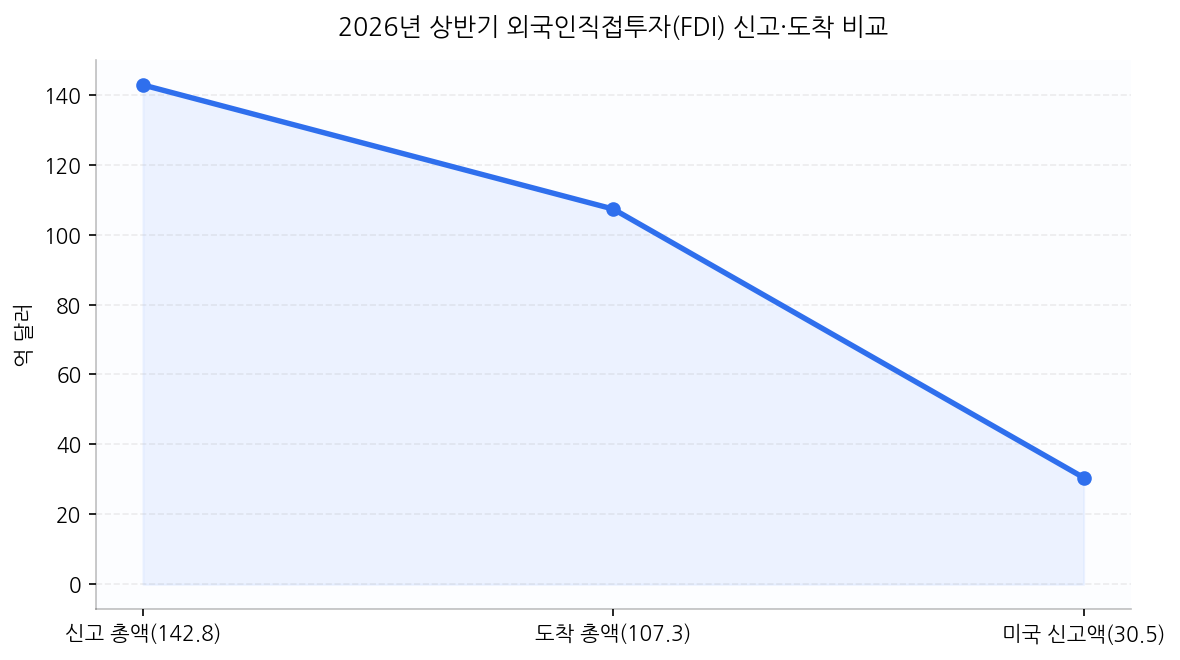
The announcement follows MOTIE’s July 3, 2026 report on first-half 2026 foreign direct investment, which showed total FDI declarations of $14.28 billion (up 9.1% year-on-year) and arrivals of $10.73 billion (up 42.6% year-on-year). (Source: https://www.motir.go.kr/kor/article/ATCL3f49a5a8c/171996/view, 2026-07-03) By country, however, U.S. investment declarations in the same period totaled $3.05 billion, down 2.5% year-on-year — meaning the September announcement arrives after a period of relatively soft U.S.-origin investment reporting. (Source: https://www.motir.go.kr/kor/article/ATCL3f49a5a8c/171996/view, 2026-07-03)
Why this matters for the United States
This is a direct U.S.-Korea investment story: all four companies are U.S.-headquartered, and the deal was signed on U.S. soil as part of an explicit bilateral push to deepen semiconductor and materials supply-chain ties amid broader trade uncertainty. (Source: https://www.korea.kr/news/policyNewsView.do?newsId=148971256, 2026-09-04) Notably, Air Products announced a similar gas-supply-network expansion for a semiconductor manufacturer in Taiwan on July 21, 2026, suggesting the same U.S. supplier is scaling capacity across multiple Asian chip hubs rather than concentrating solely on Korea. (Source: https://www.airproducts.com/company/news-center/2026/07/0721-air-products-to-expand-gas-supply-network-for-semiconductor-manufacturer-in-taiwan, 2026-07-21) Separately, TSMC continues to build out its $12 billion Arizona fab under U.S. CHIPS Act subsidies, illustrating a two-way flow of investment between the U.S. and its Asian chip-supply partners.
Industry impact
The Air Products expansion adds ultra-high-purity and rare-gas supply capacity that directly supports Korean foundries’ and memory makers’ advanced-node production lines, while Axcelis’s expansion reinforces Korea’s position as the only ion-implanter manufacturing base outside the U.S. (Source: https://www.korea.kr/news/policyNewsView.do?newsId=148971256, 2026-09-04) These materials and equipment expansions typically take one to two years to reach full operation, so near-term supply-chain effects will be limited despite the headline figure.
Consumer impact
For consumers, the effect is indirect: more stable semiconductor materials supply can eventually support steadier pricing for consumer electronics, smartphones, and automotive chips, but with a significant time lag. The more direct consumer-facing element is Pacifico Energy’s offshore wind project, which — if completed as planned — could affect regional electricity supply and renewable-energy capacity in the Jeonnam-Gwangju area. Offshore wind projects of this scale often face permitting and local-approval delays, so the announced capacity should not be treated as a fixed delivery date. (Source: https://www.korea.kr/news/policyNewsView.do?newsId=148971256, 2026-09-04)