![[2026-08-06] 소부장 슈퍼 을 3기·협력모델 5건 좌담 — 910억 R&D 승부수, 중국 1,300억 유로대 공급망 전쟁에서 통할까](https://metaqsol.com/wp-content/uploads/2026/08/hero_orig.jpg)
On August 6, 2026, South Korea’s Ministry of Trade, Industry and Energy (MOTIE) held the 16th Materials, Parts and Equipment (so-bu-jang) Competitiveness Committee meeting at the Korea Trade Insurance Corporation in Seoul. The committee approved five new so-bu-jang cooperation-model projects, designated five companies as the third round of “Super Eul” core suppliers, and finalized the 2026 implementation plan under the second Basic Plan for Materials, Parts and Equipment Competitiveness (2026-2030).
What was approved
The five newly approved cooperation models cover next-generation glass package substrates and 1000W-class EUV pellicles (“ecosystem-completion” type), a factory-customized mobility platform (“region-led” type), and a domestic SoC for vehicle infotainment plus ultra-high-performance porous carbon for energy applications (“general” type). Over the next five years, the government will provide a combined 91 billion won (about $65 million) in R&D funding for these projects, bundled with regulatory fast-tracks for chemical approvals, policy financing and tax incentives.
Separately, the third-round “Super Eul” companies are Hanwha Ocean (submarine fuel-cell core equipment), Sunic System (AI-based autonomous OLED deposition equipment), EO Technics (ultra-fast laser heat-treatment equipment), Ecopro BM (sulfide-based solid electrolyte for solid-state batteries), and Doosan Enerbility’s electronics unit (low-loss satellite-communication materials and antenna modules). Each Super Eul company can receive up to 20 billion won per project over at least seven years, with MOTIE targeting a total of 15 such companies by 2030.
How it compares — the US, EU, Japan and China are spending far more
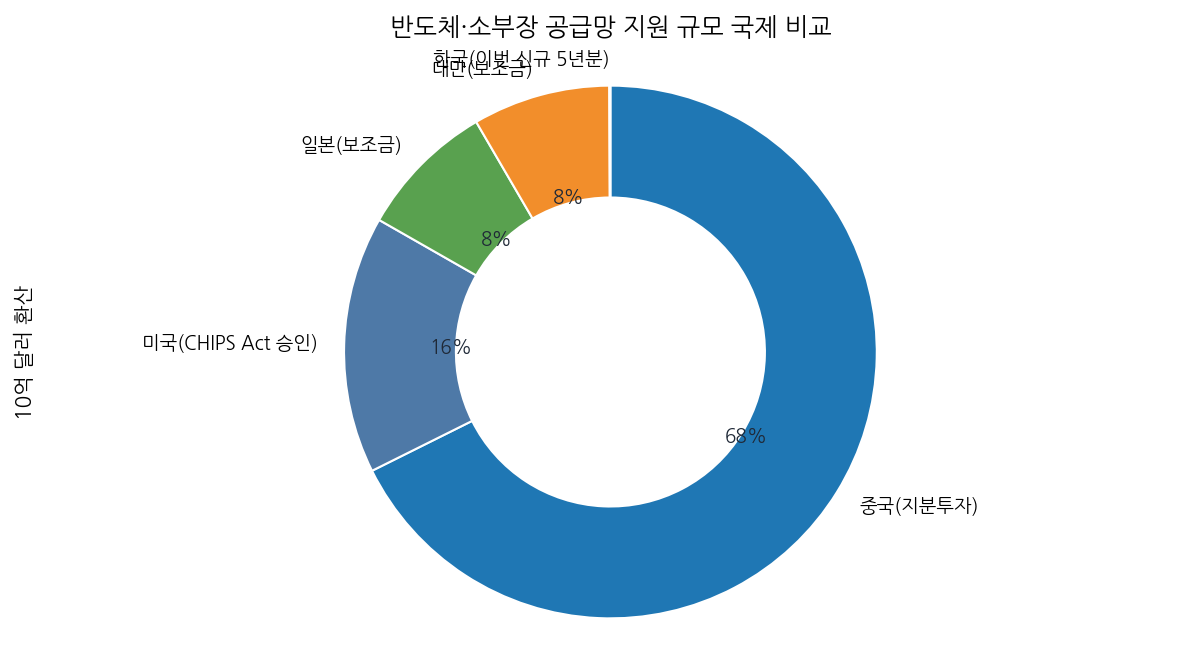
Placed next to global peers, Korea’s new package is small in absolute terms. The US CHIPS and Science Act (2022) allocated $50 billion directly to semiconductors ($39 billion in manufacturing incentives, $11 billion in R&D), and as of early 2026 had approved $33.7 billion in grants and $5.5 billion in loan guarantees, according to a Bruegel analysis cited on Wikipedia’s European Chips Act page. The EU’s own Chips Act (2023) targeted at least €42 billion in public investment (rising to at least €86 billion including expected private-sector matching), but only €13.75 billion in national state aid had actually been approved by early 2026 — a sizeable implementation gap. The same analysis put Japan’s semiconductor subsidies at €16.7 billion, Taiwan’s at €16.7 billion, and China’s equity-based state investment at €135.2 billion, by far the largest figure among the group.
Why this matters to the United States. Korea’s so-bu-jang program targets the same materials and equipment layer — glass substrates, EUV pellicles, solid-state battery electrolytes — that US chipmakers and battery producers depend on for supply-chain diversification away from Chinese suppliers. Ecopro BM’s solid electrolyte work is directly relevant to the US battery supply chain being built out under the Inflation Reduction Act and CHIPS Act ecosystem, and Doosan’s satellite-communication materials intersect with US defense-industrial cooperation. A faster, cheaper Korean materials ecosystem could either compete with or complement US reshoring efforts, depending on how trade and investment terms evolve.
Industry impact
The most direct beneficiaries are the five Super Eul companies, particularly Ecopro BM, which gains multi-year funding for solid-state battery electrolyte development — a technology race that also involves Samsung SDI, LG Energy Solution, Toyota and QuantumScape. Hanwha Ocean’s and Doosan’s projects tie into defense and aerospace supply chains, areas MOTIE has separately prioritized (see our Yongin semiconductor cluster acceleration piece). However, cooperation-model approvals typically take three to five years to reach commercialization, so near-term earnings impact for listed suppliers should be limited.
Consumer impact
Consumers will not see immediate effects from an R&D funding decision. Over the medium term, however, reduced import dependence for critical semiconductor and battery materials could dampen price volatility in finished goods such as electric vehicles and consumer electronics during future supply shocks or export-control disputes. The designation of a third round of “so-bu-jang specialized industrial complexes,” planned for later in 2026, will determine how much of this investment translates into regional manufacturing jobs.
Sources
- Government approves 5 so-bu-jang cooperation models, 91 billion won in 5-year R&D funding (Korea Policy Briefing)
- Government adds 5 so-bu-jang cooperation models, names new Super Eul companies (Asiae)
- CHIPS and Science Act — funding breakdown (Wikipedia)
- European Chips Act — Bruegel 2026 comparative funding analysis (Wikipedia)