![[2026-09-04] 중소기업 수출 1800억 달러 목표, 국정과제 300억 달러 상향 조정이 말하는 것](https://metaqsol.com/wp-content/uploads/2026/09/hero_ai-5.png)
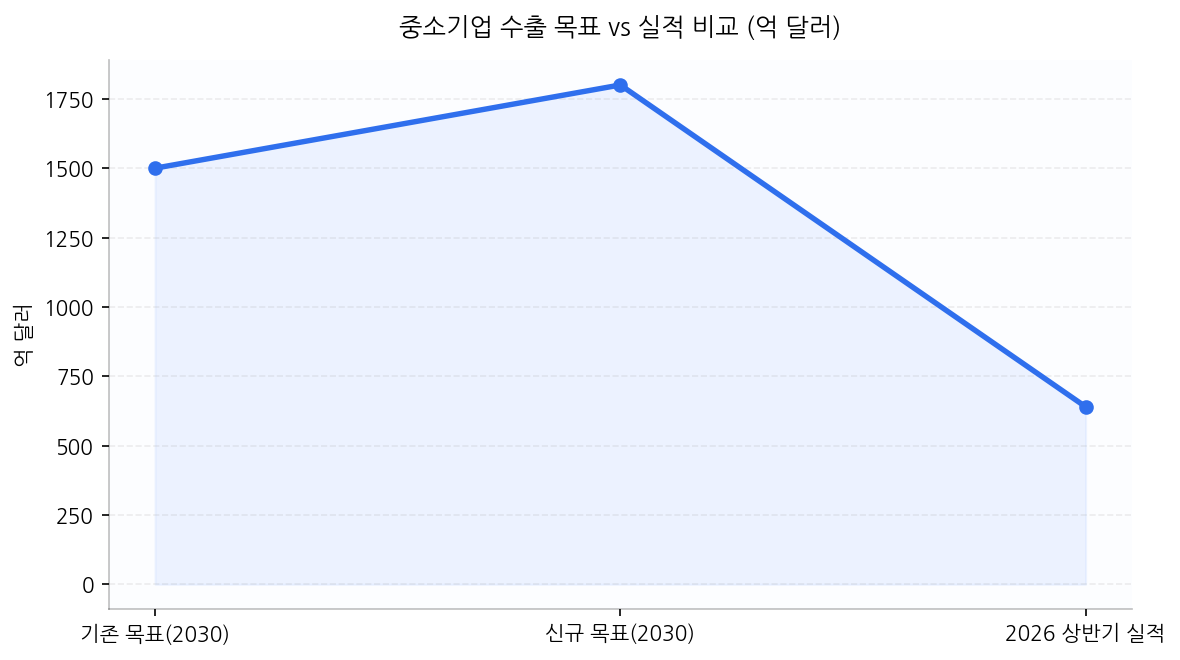
South Korea’s Ministry of SMEs and Startups (MSS) announced a ‘4 Innovation Strategies for SME Exports’ plan on September 3, 2026, raising the national target for small and medium enterprise (SME) exports from $150 billion to $180 billion by 2030 — a $30 billion increase from the prior state agenda goal. (Source: https://www.korea.kr/news/policyNewsView.do?newsId=148971172, 2026-09-03) The revision was justified by first-half 2026 SME export results of $64 billion, a record for any half-year period. (Source: https://www.korea.kr/news/policyNewsView.do?newsId=148971172, 2026-09-03)
What the strategy covers
The plan restructures support across four areas: companies, products, countries, and policy systems. Two flagship programs anchor the company-side approach. ‘Global Scale-Up 500’ will provide multi-year, bundled support to 500 high-potential exporting companies, helping them build export roadmaps and scale into new markets. ‘Export ON 2000’ targets 2,000 companies — including youth entrepreneurs, small merchants, regional firms, and companies re-entering export markets after past failures — to convert them into new exporters. (Source: https://www.korea.kr/news/policyNewsView.do?newsId=148971172, 2026-09-03)
On the product side, the government designated consumer goods such as fashion, food, and beauty devices as ‘K-Brand Strategic Items,’ to be promoted through partnerships with large domestic retail and media companies. Industrial and tech products are being grouped into ‘K-Tech Strategic Items,’ with joint proof-of-concept projects planned alongside major domestic and global corporations. (Source: https://www.korea.kr/news/policyNewsView.do?newsId=148971172, 2026-09-03)
Five target markets, five different playbooks
The strategy names five specific markets for country-tailored support, converting recent state-visit diplomacy into concrete export channels: India (a combined exhibition and logistics hub connected to local venture capital and universities), Singapore (a startup-focused hub and a global venture fund called K-VCC), Brazil (stronger cooperation with local regulators to support K-beauty market entry), Europe (a permanent K-Brand pop-up store network), and Mongolia (leveraging local convenience-store retail infrastructure). (Source: https://www.korea.kr/news/policyNewsView.do?newsId=148971172, 2026-09-03) Why this matters for global readers: the mix signals Korea does not yet have a dominant beachhead in any single overseas market, and is instead testing distinct entry models — infrastructure-heavy in India, fund-based in Singapore, regulatory-cooperation-based in Brazil — that international investors and trade partners can benchmark against their own market-entry frameworks.
How this compares to Germany and Japan
Germany’s Federal Ministry for Economic Affairs and Climate Action (BMWE) runs its SME export support under the umbrella brand ‘Mittelstand Global,’ which channels assistance through a network of more than 120 German Chambers of Commerce Abroad (AHK) worldwide, providing on-the-ground market information and networking. (Source: https://taiwan.ahk.de/en/services/delegations/market-entry-programme, program description as of 2026-01-01) Where Korea’s ‘Export ON 2000’ identifies companies domestically and pushes them outward, Germany’s model relies on chambers already embedded in the destination market to receive incoming firms.
Japan’s approach, announced closer in time to Korea’s, differs in structure. JETRO opened applications in April 2026 for an ‘export support ecosystem formation subsidy’ for mid-size and small enterprises, explicitly excluding projects that would benefit only a single company — applicants must form a consortium of at least two private export-support providers. (Source: https://www.jetro.go.jp/news/announcement/2026/bbfdd425d0707fc5.html, 2026-04-27) Japan is investing in the support ecosystem itself rather than funding company-to-company assistance directly, a structural choice Korea’s plan does not mirror, even though Korea’s own strategy includes similar infrastructure elements such as consolidated application portals and AI-based buyer matching.
Industry impact
The most concrete operational change is the expansion of Korea’s export voucher program to cover raw-material sourcing, not just overseas marketing as before. (Source: https://www.korea.kr/news/policyNewsView.do?newsId=148971172, 2026-09-03) This gives small manufacturers a new lever for supply-chain stability, though how quickly the expanded scope translates into actual budget allocation and faster application processing depends on implementation rules not yet published.
Consumer impact
For consumers, the K-Brand designation for fashion, food, and beauty devices means Korean SME products may gain overseas visibility first, then circle back to premium positioning in the domestic market — a pattern already visible in K-beauty. The risk worth flagging is that leaning on large retailers’ distribution networks could deepen SME dependence on those channels rather than building independent brand equity.
Who should move first
Companies re-entering export markets after a prior failure have historically been a policy blind spot in Korea; the new dedicated re-entry track makes them an early-mover opportunity. Mid-size consumer goods firms already scouting India, Singapore, or Brazil also stand to gain the most by entering while government-backed local infrastructure and regulatory cooperation are still being built out.