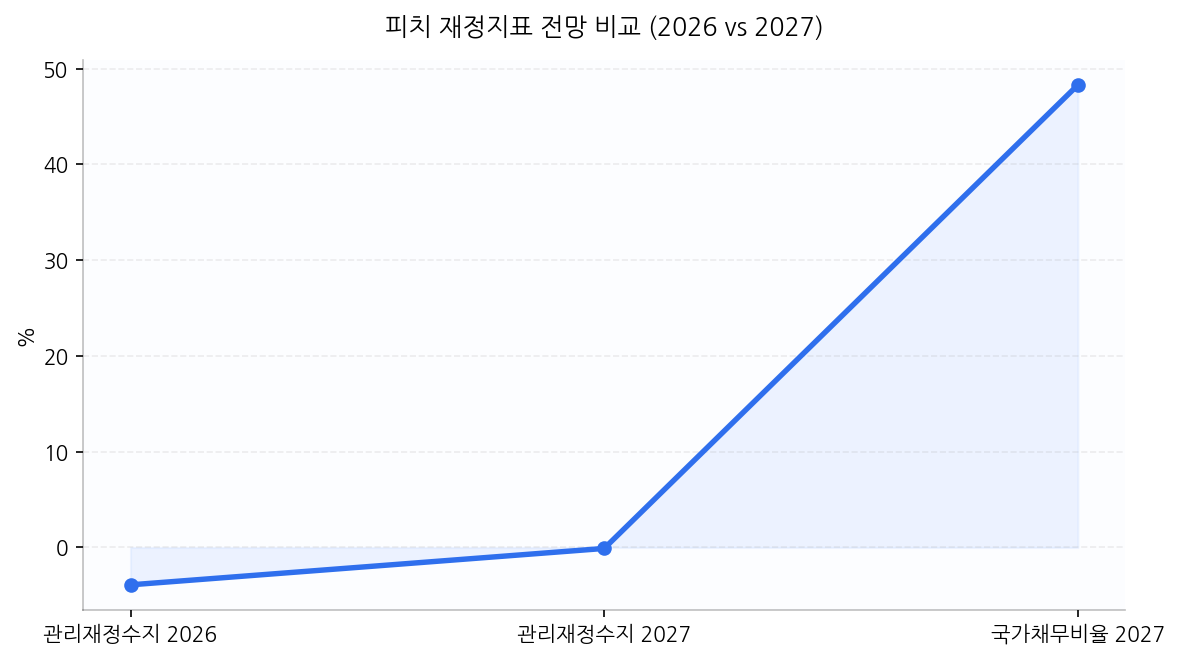
International credit rating agencies Fitch and Moody’s issued back-to-back positive assessments of South Korea’s 2027 budget, in reports dated September 9 and September 3, 2026, respectively (source: Korea’s Ministry of Economy and Finance via korea.kr, 2026-09-09). Fitch projected Korea’s managed fiscal balance improving from -3.9% of GDP in 2026 to -0.1% in 2027, with the national debt ratio falling to 48.3%, below its previous forecast of 51.7%. Moody’s said the budget strikes a balance between securing fiscal soundness and expanding future growth drivers. Both agencies flagged that the improvement is heavily tied to a surge in AI- and semiconductor-related tax revenue.
Why This Matters for International Investors
For foreign bondholders and investors tracking Korea’s sovereign risk, this is a directly relevant signal. A lower national debt ratio and narrower fiscal deficit typically support tighter sovereign bond spreads and lower borrowing costs for the government (source: korea.kr, 2026-09-09). Fitch’s report noted Korea’s 2027 budget of 820 trillion won, alongside a separate 162 trillion won future-response fund, contributed to the stronger fiscal outlook (source: Korea Economic Daily via Bloomingbit, 2026-09-09). Separately, S&P affirmed Korea’s sovereign credit rating at ‘AA, stable’ on April 29, 2026, forecasting Korea’s per-capita GDP would grow 2.1% annually to exceed $44,000 by 2029, and general government fiscal deficit narrowing from -1.4% in 2026 to -1.1% in 2027 (source: korea.kr policy briefing, 2026-04-30).
The Semiconductor Dependency Caveat
Fitch explicitly warned that because the recent tax revenue surge depends on the AI and semiconductor boom, the fiscal deficit could gradually widen again once the semiconductor industry normalizes (source: korea.kr, 2026-09-09). Moody’s echoed this, stressing that whether expanded spending stays on plan and whether strategic-industry investment translates into productivity gains will be the key test for the rating outlook going forward (source: korea.kr, 2026-09-09).
A Comparable Case: Taiwan
Taiwan offers a useful comparison. S&P affirmed Taiwan’s sovereign rating at ‘A’ on April 29, 2026, noting Taiwan’s 2025 general government deficit came in at 0.8% of GDP, better than the budgeted target of 1.1%, also driven primarily by strong semiconductor-sector earnings (source: S&P Global Ratings, 2026-04-29). Both Korea and Taiwan now show fiscal health closely tied to a single industry cycle — Taiwan’s concentration is even sharper given TSMC’s outsized share, while Korea’s base is somewhat broader across Samsung Electronics, SK Hynix, and the wider materials-parts-equipment ecosystem.
Industry Impact
For Korea’s semiconductor and export sectors, the rating agencies’ recognition of their fiscal contribution is a reputational positive for external credibility. But the flip side is structural: if the current fund allocation toward the 162 trillion won future-response fund does not translate into diversified growth investment, Korea’s fiscal position remains exposed to the next down-cycle in chip demand. This dynamic parallels Korea’s recent trade finance expansion from 120 trillion won to 140 trillion won for exporters (source: metaqsol coverage, 2026-09-09), which similarly assumes continued export strength, and the Louisiana steel mill groundbreaking on September 4, 2026 (local time), part of the broader Korea-US supply chain realignment (source: metaqsol coverage, 2026-09-07).
Consumer Impact
For ordinary Korean households, a stable or improving sovereign rating can indirectly support lower government bond yields and broader financial market stability, though it does not directly translate into lower consumer loan rates, which are driven more by the Bank of Korea’s policy rate and bank lending spreads. If the semiconductor cycle turns down and the fiscal metrics reverse, pressure could shift toward welfare and support-program budgets, making the fund’s actual execution transparency an important issue to watch.
Source: Ministry of Economy and Finance via korea.kr (2026-09-09) · References: Fitch Ratings · korea.kr, S&P Korea AA rating (2026-04-30) · S&P Global, Taiwan Rating Affirmed (2026-04-29)