Korea’s Deputy Prime Minister and Minister of Economy and Finance Koo Yun-cheol chaired an emergency economic response meeting on 2026-09-18 and announced that the country’s fuel tax reduction, originally set to expire at the end of September, will be extended by two months through the end of November. (Source: https://www.korea.kr/news/policyNewsView.do?newsId=148972202, 2026-09-18) The gasoline tax cut stays at 15%, while diesel and butane — used heavily in logistics, industry, and small trucks — keep a higher 25% reduction. (Source: https://www.korea.kr/news/policyNewsView.do?newsId=148972202, 2026-09-18) During the Chuseok holiday period (September 24-27), fuel prices at highway rest-stop gas stations managed by the Korea Expressway Corporation will be cut by an additional 100 KRW per liter compared to September 17 prices. (Source: https://www.korea.kr/news/policyNewsView.do?newsId=148972202, 2026-09-18) Separately, the Ministry of Trade, Industry and Energy announced that the 10th round of the maximum oil price ceiling, effective from September 19 for four weeks, will remain frozen at the same level as the 9th round: 1,784 KRW per liter for gasoline, 1,773 KRW for diesel, and 1,380 KRW for kerosene. (Source: https://www.korea.kr/news/policyNewsView.do?newsId=148972202, 2026-09-18)
Background: a history of short-term extensions
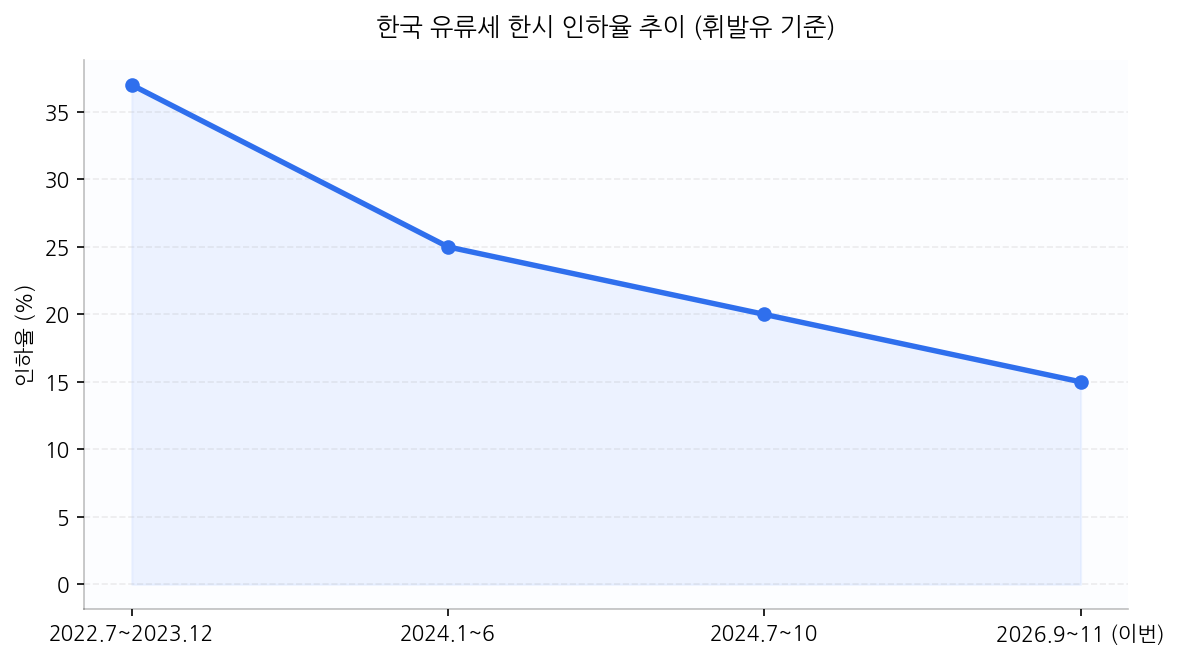
Korea has repeatedly extended and adjusted its fuel tax reduction since international oil prices began rising sharply. From July 2022 to December 2023, the cut reached a record 37% for both gasoline and diesel; it was reduced to 25% for gasoline and 37% for diesel from January to June 2024, then to 20% and 30% respectively from July to October 2024. (Source: https://taxcalc.co.kr/other/fuel.html, 2026-08-11) The reduction lapsed entirely in 2025 before returning at the current 15%/25% split in response to renewed oil price pressure tied to Middle East tensions. (Source: https://taxcalc.co.kr/other/fuel.html, 2026-08-11) Under the standard tax rate, fuel taxes make up roughly 53% of the retail gasoline price in Korea, at about 906 KRW per liter combining the transport-energy-environment tax, education tax, driving tax, and VAT. (Source: https://taxcalc.co.kr/other/fuel.html, 2026-08-11)
Industry impact
The higher 25% cut retained for diesel and butane provides more relief to logistics, construction equipment, and small commercial vehicle operators than to passenger-car gasoline users. (Source: https://www.korea.kr/news/policyNewsView.do?newsId=148972202, 2026-09-18) However, the short two-month extension window leaves freight and logistics operators with limited visibility into fuel costs beyond late November, since another extension has not been confirmed.
Consumer impact
Consumers should note that the 100 KRW/liter highway discount applies only to Korea Expressway Corporation-managed rest-stop stations during the four-day Chuseok holiday window (September 24-27), not to fuel prices nationwide or beyond that period. (Source: https://www.korea.kr/news/policyNewsView.do?newsId=148972202, 2026-09-18) The separately maintained 15%/25% tax reduction, in contrast, runs through the end of November. Electric vehicle owners can also access discounted charging rates during daytime hours over the holiday, when solar power supply is typically abundant. (Source: https://www.korea.kr/news/policyNewsView.do?newsId=148972202, 2026-09-18)
How Korea’s mechanism compares structurally
Korea’s percentage-based tax cut mechanism — reducing the tax rate itself rather than paying a fixed per-liter subsidy — means the discount scales up automatically in won terms as pre-tax prices rise, but also scales down if oil prices fall. (Source: https://taxcalc.co.kr/other/fuel.html, 2026-08-11) This structural feature is specific to how Korea’s fuel tax is calculated as a percentage of a multi-component tax base (transport-energy-environment tax, education tax, driving tax, and VAT), rather than as a flat per-liter amount. (Source: https://taxcalc.co.kr/other/fuel.html, 2026-08-11)
Source: Korea Policy Briefing, 2026-09-18 · Reference: Korea fuel tax history, 2026-08-11 · Related: Korea’s 2027 budget family support package