As of June 26, 2026 | Companion piece to our prior US edition: LIT vs BATT vs ILIT — 2026 US Lithium & Battery ETF Deep Dive.
Why Korean Battery ETFs Are Rebounding in 2026
After the brutal 2024–2025 EV “chasm” and the collapse of lithium prices, Korean battery ETFs have rallied sharply in 2026. BYD raised its 2026 overseas sales target from 1.3 million to 1.5 million units, China announced a doubling of EV charging capacity to 180 GW by 2027, and Ganfeng Lithium’s chairman projected global lithium demand to grow 30–40% in 2026. Battery-grade lithium carbonate spot prices have crossed USD 27/kg and trended upward through Q2 2026.
For Korean retail investors (or foreign investors trading the KOSPI), three ETFs dominate the domestic battery-theme universe: TIGER Secondary Battery Theme (305540), KODEX Secondary Battery Industry (305720), and TIGER Global Lithium & Battery Solactive Synthetic (394670). This article benchmarks all three against the US flagship — Global X Lithium & Battery Tech (LIT) — across fees, holdings concentration, and trailing returns.
At a Glance — Korea 3 + US LIT
| Metric | TIGER 2nd Battery Theme | KODEX 2nd Battery Industry | TIGER Global Lithium | (US) LIT (ref.) |
|---|---|---|---|---|
| Ticker | 305540 | 305720 | 394670 (Synthetic) | LIT (NYSE) |
| Issuer | Mirae Asset | Samsung Asset Mgmt | Mirae Asset | Global X |
| Index | WISE 2nd Battery Theme (PR) | FnGuide 2nd Battery Industry | Solactive Global Lithium (PR) | Solactive Global Lithium |
| Structure | Physical (KR only) | Physical (KR only) | Synthetic (TRS) | Physical (Global) |
| Total Fee | 0.50% | 0.55% | 0.49% (mgmt) | 0.75% |
| AUM | ~KRW 921B | ~KRW 2.36T | ~KRW 307B | ~USD 1.91B |
| Holdings | ~24 | 33 | 30 (via index swap) | 41 |
| Focus | KR cell + materials | KR battery value chain | Global lithium + battery | Global lithium + battery |
The Fee Trap — Headline Fee vs Real TER
The headline “management fee” published by the issuer is not what investors actually pay. Total Expense Ratio (TER) layers on other costs and brokerage commissions; for synthetic ETFs, swap costs are added on top. Just as we found in the prior US lithium ETF comparison, the cheapest-looking fund on the label is not always the cheapest fund in reality.
| Cost Layer | 305540 | 305720 | 394670 | LIT |
|---|---|---|---|---|
| Headline management fee | 0.45% | 0.45% | 0.40% | 0.75% |
| Other costs (incl. swap) | ~0.05–0.10% | ~0.10% | ~0.07–0.16% swap | spread/trading |
| Estimated real TER | ~0.50–0.55% | ~0.55% | ~0.56% (synth) | ~0.75% |
| FX exposure | None (KRW) | None (KRW) | USD-exposed | USD asset |
The key insight: the three Korean ETFs are bunched between 0.50–0.56% real TER, while US LIT runs significantly higher at 0.75%. However, LIT offers broader global value-chain exposure (mining, refining, OEMs), which the KRW-denominated Korean ETFs cannot replicate without taking FX exposure via 394670.
Holdings Concentration — The Critical Detail
TIGER 2nd Battery Theme (305540) — Top 5
| Rank | Stock | Weight |
|---|---|---|
| 1 | Samsung SDI | 17.37% |
| 2 | LG Energy Solution | 15.46% |
| 3 | POSCO Holdings | 15.09% |
| 4 | LG Chem | 14.80% |
| 5 | POSCO Future M | 6.66% |
KODEX 2nd Battery Industry (305720) — Top 5
| Rank | Stock | Weight |
|---|---|---|
| 1 | Samsung SDI | 20.43% |
| 2 | LG Energy Solution | 18.33% |
| 3 | POSCO Holdings | 12.39% |
| 4 | EcoPro BM | 10.08% |
| 5 | LG Chem | 9.35% |
TIGER Global Lithium & Battery (394670) — Synthetic Structure
394670 is a synthetic replication ETF. Direct holdings on the fund report show only 2 line items (the total-return swap counterparty exposure), but the economic exposure is to the full Solactive Global Lithium Index — 30 names including Albemarle, SQM, Pilbara Minerals, Ganfeng, Tianqi, CATL, BYD, Samsung SDI, and LG Energy Solution. Synthetic structures generally yield lower tracking error but introduce counterparty credit risk (typically a global IB).
Trailing Returns (as of 2026-06-26)
| Period | 305540 | 305720 | 394670 | (US) LIT |
|---|---|---|---|---|
| 1-month | -21.16% | ~-10% range | -5.53% | — |
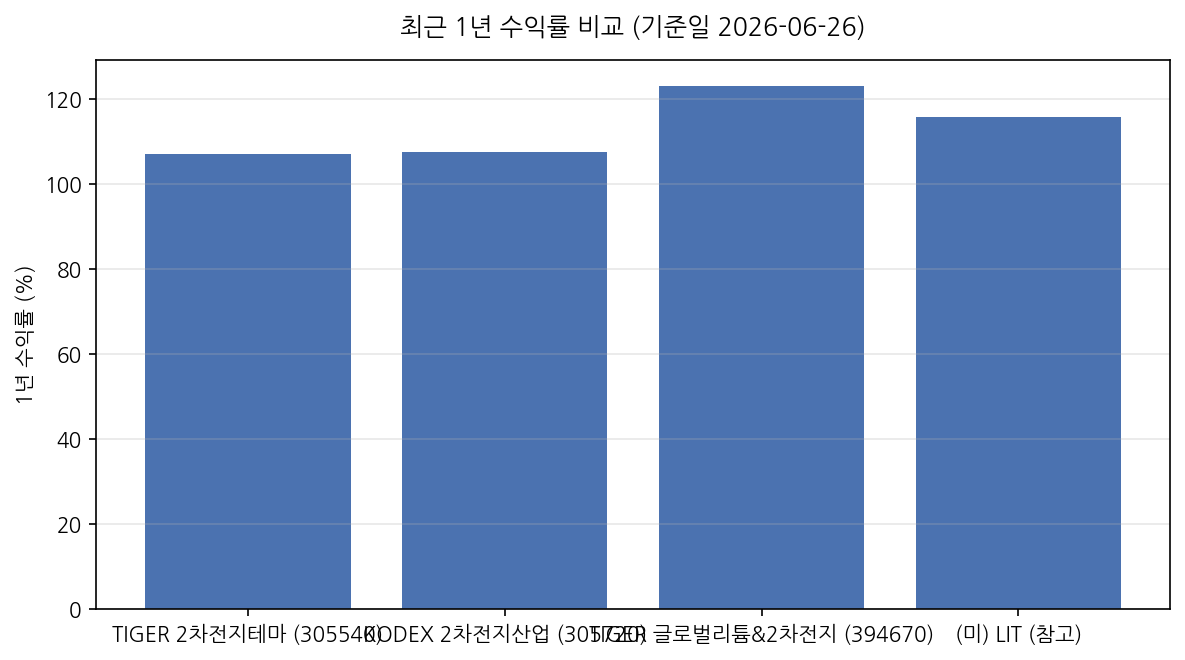
| 1-year | +107.06% | +107.54% | +122.95% | +115.60% |
| 3-year | -5.62% | -10.88% | +16.11% | — |
Key observation: 1-year returns favor global-diversified 394670 at +122.95%, while the KR cell/materials-heavy 305540 and 305720 cluster around +107%. The recent 1-month -21% drop in 305540 hints that the market is beginning to price renewed chasm risk. Only 394670 sits in positive territory on a 3-year cumulative basis.
Risks to Understand
- Concentration risk: KR 305540/305720 carry ~70% in the top 5, with Samsung SDI + LGES + LG Chem alone exceeding 50%. Effectively a “Big 3 cells” ETF — limited diversification beyond direct stock buys.
- Raw-material price volatility: Lithium carbonate fell below CNY 60,000/ton in 2024 and rebounded to USD 27/kg in 2026 — almost a linear function of fund NAVs.
- LFP vs NCM rotation: 2023 share NCM 46% / LFP 37% is expected to flip to NCM 37.3% / LFP 46.2% by 2026. Korean cell makers are NCM-heavy, exposing 305540/305720 to a structural headwind.
- Synthetic counterparty risk: 394670’s TRS structure carries credit risk to the swap counterparty. Tracking error is low, but recovery risk in stress scenarios should be acknowledged.
- FX risk: 394670 is USD-exposed; KRW/USD swings move NAV directly. 305540/305720 are pure KRW assets — no FX risk, but no global diversification either.
US LIT vs the Korean Three — Direct Comparison
Pulling forward the LIT data from our prior US edition:
| Axis | KR 305540 / 305720 | KR 394670 | US LIT |
|---|---|---|---|
| 1-year return | ~+107% | +122.95% | +115.60% |
| TER | 0.50–0.55% | ~0.56% | 0.75% |
| FX risk | None (KRW) | Yes (USD) | Yes (direct USD) |
| Coverage | KR cell + materials | Global full chain | Global full chain |
| Access | KR broker (instant) | KR broker (instant) | Requires foreign-equity account |
| Tax | Capital gains taxed as dividend income (15.4%) | Same | Foreign-equity capital gains tax (22%, KRW 2.5M annual exemption) |
Bottom line: if you want global exposure plus FX upside, LIT or 394670; if you want a pure KRW-denominated bet on Korea’s Big 3 cell makers, 305720; if you want a touch more materials/equipment names alongside the cell-makers, 305540. LIT charges the highest fee but offers the most comprehensive global value-chain coverage.
Recommendations by Investor Profile
- Pure KRW bet on Korean Big 3 cells: KODEX 2차전지산업 (305720) — largest AUM, cleanest KR cell exposure, 33-name diversification.
- Slight tilt to materials/equipment: TIGER 2차전지테마 (305540) — similar top holdings but keyword-driven index includes a few additional materials names.
- Want global mining + OEM and willing to take FX: TIGER Global Lithium & Battery (394670) — effectively a “Korean LIT”, buyable in KRW via domestic brokers. Understand synthetic structure first.
- Foreign-equity account holder seeking USD-denominated exposure: LIT direct — higher fee but unmatched liquidity and AUM.
FAQ
Q1. Which Korean battery ETF is safest?
It depends on the definition. By AUM and liquidity, KODEX 2차전지산업 (305720) dominates. By smallest 3-year drawdown, TIGER Global Lithium & Battery (394670) is the only one in positive territory. But 394670 carries synthetic-counterparty risk that 305720 and 305540 do not — so on “structural simplicity” the physical-replication pair wins.
Q2. Can a Korean ETF replace US LIT?
The closest proxy is TIGER Global Lithium & Battery (394670) — both track Solactive Global Lithium family indices. However, 394670 is synthetic (TRS) while LIT is physical replication. Fees actually favor 394670. For Korean investors without a foreign-equity account, 394670 is effectively the “Korean LIT”.
Q3. Does LFP’s rise above NCM hurt Korean ETFs?
Structurally, yes. The top 5 holdings of 305540/305720 concentrate in NCM-strong LG Energy Solution, Samsung SDI, and LG Chem. However, Korean cell makers are aggressively investing in LFP capacity, and ESS demand for LFP is booming — capturing both-sided demand. Short-term price moves still track lithium and nickel raw-material prices more than chemistry mix.
How to Buy These ETFs
For Korean residents
All three Korean ETFs (305540, 305720, 394670) are listed on KOSPI and tradeable through any domestic broker (Korea Investment, Mirae Asset, NH, Kiwoom, Samsung Securities, etc.) using a standard equity account. Settlement is T+2 in KRW. There is no minimum holding period, and you can buy fractional units in the form of one share — typical lot is one share, with current prices in the KRW 12,000–18,000 range. Capital gains are taxed at the 15.4% dividend-income rate; if your annual financial income exceeds KRW 20 million, comprehensive taxation kicks in. ETFs traded inside an ISA or pension account (IRP, 연금저축) receive preferential treatment.
For foreign investors (US/EU/JP)
Foreign investors can access the KOSPI-listed Korean ETFs through international brokers that support Korean equities (Interactive Brokers, Saxo Bank, some local brokers with Korea access). Note that the Foreign Investor Registration Certificate requirement was abolished in 2024, simplifying access. Alternatively, foreign investors can simply buy LIT directly on NYSE — same global lithium exposure, similar fee profile, in USD without crossing borders.
Practical sizing guidance
Given the cyclicality of battery raw materials and EV demand, most asset allocation frameworks treat battery ETFs as tactical/thematic positions sized at 3–8% of equity sleeve rather than core holdings. Concentrated names (Samsung SDI, LG Energy Solution) inside the Korean ETFs mean that pairing 305720 with KOSPI 200 or KODEX 200 creates substantial double-counting. Investors already holding LGES or Samsung SDI directly should size the battery ETF position downward accordingly to avoid stacking.
Related Reading
- [US] LIT vs BATT vs ILIT — 2026 US Lithium/Battery ETF Deep Dive
- [KR] Korean AI/Semiconductor ETF Deep Comparison