Source: Korea Policy Briefing Press Release (June 26, 2026) — Ministry of Science and ICT
Policy Overview
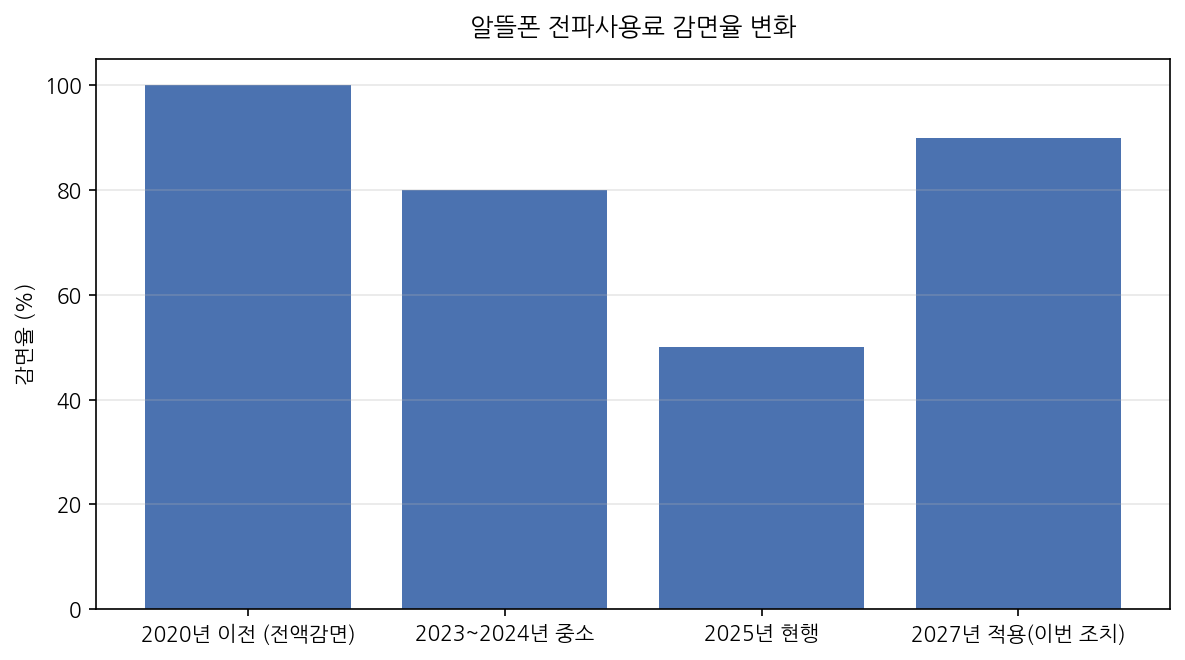
South Korea’s Ministry of Science and ICT (MSIT) announced on June 26, 2026, that the spectrum usage fee waiver rate for small and mid-sized MVNO operators will be expanded from the current 50% to 90%, with the discount period extended by three years. The change is set to take effect in 2027 following a revision of the Radio Waves Act enforcement ordinance in the second half of 2026.
The spectrum usage fee is paid by telecom operators for using radio frequencies — a limited national resource. The base rate is 2,000 KRW per line per quarter; the actual burden after discount coefficients is approximately 1,200 KRW per line. Under 90% waiver, the per-line cost for qualifying operators drops to roughly 120 KRW — nearly a full exemption.
Background: Korea’s MVNO Market Under Pressure
Korea’s MVNO market (locally called “알뜰폰” or budget phones) holds approximately 17.5% of the total mobile subscriber base as of 2025, with close to 10 million users. MVNOs charge roughly half the price of the three major carriers — SK Telecom (~40% share), KT (~24%), and LG Uplus (~18%) — and are disproportionately used by young adults and low-income households.
However, the sector faces significant financial strain. Of 58 MVNO operators tracked in 2023, 21 (39.6%) reported operating losses. Only one operator posted operating profit above 10 billion KRW (~USD 7.4 million). The waiver rate for small and mid-sized operators was reduced from 80% to 50% in 2025 — intensifying financial pressure and threatening the viability of the MVNO ecosystem.
Industry Impact
- Small MVNO operators: Lower cost burden enables more competitive low-cost plan launches. Eases survival pressure on loss-making operators.
- Major carriers (SKT, KT, LGU+): Renewed MVNO price competition may accelerate their own 5G budget plan launches. The government is also pushing major carriers to lower 5G entry-level plans from the mid-30,000 KRW range to 20,000–30,000 KRW.
- Ancillary markets: Online self-registration platforms and unlocked device markets are expected to benefit from an MVNO market resurgence.
Consumer Impact
- 10 million MVNO users: No automatic price reduction, but operators gaining cost relief are more likely to launch lower-priced plans.
- Data quality: MSIT will extend the “Data Safety Option” (QoS) — allowing ~400 Kbps speeds even after exhausting the monthly data allowance — to MVNO subscribers.
- Upcoming comprehensive plan: A full household telecom cost reduction package is expected before August 2026, which may include major carrier rate cuts.
Why This Policy Is Relevant Beyond Korea
Korea’s approach mirrors international efforts to sustain MVNO market health as a tool for household telecom cost reduction. Japan’s Ministry of Internal Affairs and Communications pursued a similar MVNO activation strategy in 2017–2018, contributing to lower mobile bills for Japanese consumers. The UK’s Ofcom has used access charge regulation to maintain healthy MVNO competition. Korea’s direct subsidy model (fee waivers) differs from the regulatory competition model, but serves the same structural goal: keeping budget telecom options affordable and accessible. For foreign investors in Korean telcos and for policymakers in markets facing MVNO sector stress, Korea’s intervention offers a relevant reference point.
Sources
- MSIT Press Release — MVNO Spectrum Fee Waiver Expansion (June 26, 2026)
- Digital Daily — Government raises MVNO waiver to 90% (June 26, 2026)
- The Elec — MVNO spectrum fee waiver extended (2024)
Source: https://www.korea.kr/briefing/pressReleaseView.do?newsId=156768305&call_from=rsslink