Why This Policy Matters Globally
South Korea’s President Lee Jae-myung unveiled the nation’s largest-ever regional investment initiative on June 29–30, 2026: an 800 trillion KRW (~$580B) megaproject targeting the Southwest region (Jeollanam-do, Gwangju, Jeollabuk-do). The initiative directly affects global semiconductor supply chains, offshore wind markets, and investors tracking Korea’s industrial policy.
Key Announcements
Samsung Electronics announced 425 trillion KRW (~$310B) total investment in the Honam (Southwest) region: 400 trillion KRW for two new semiconductor fabs in Gwangju (Korea’s next cluster after Pyeongtaek/Yongin), 17 trillion KRW for Samsung SDS to build a 210MW-class AI data center in Haenam Solarside (operational 2028), 4 trillion KRW in future energy (solar, hydrogen R&D by Samsung C&T), and 4 trillion KRW in smart home appliance innovation factories. SK Hynix and Amkor Technology Korea also signed MOUs.
Offshore Wind: 306 Trillion KRW, 20-Year Market
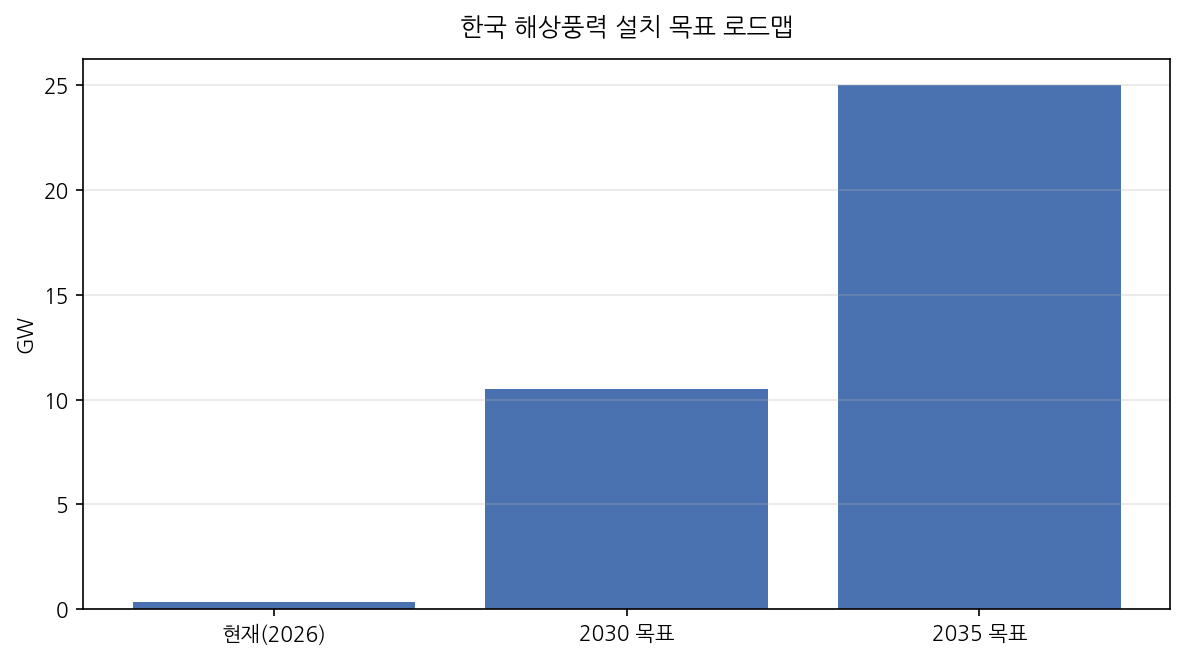
The government targets 10.5GW by 2030 and 25GW by 2035, from just 0.36GW currently operational (1% of 34GW permitted). The 20-year market is estimated at 306 trillion KRW (9 trillion KRW per GW lifecycle cost). Levelized cost target: current 330 KRW/kWh → 250 KRW (2030) → 150 KRW (2035). The Yeongwang Nakwol offshore wind farm (365MW, 64 turbines) is at 85% completion — the most advanced project in Korea.
Overseas Comparison & Key Figures
UK’s Hornsea Three (2.9GW, Ørsted) created 1,200 Grimsby port jobs immediately upon FID — Korea’s Mokpo Port-centered supply chain mirrors this model. Denmark’s community revenue-sharing is adapted as Sinan County’s ‘Sunshine Child Allowance.’ Samsung’s vice chairman publicly requested nuclear power expansion and LNG cogeneration, signaling Korea will pursue a mixed energy portfolio (offshore wind + nuclear + LNG) rather than renewables-only.
- Southwest total investment: 800 trillion KRW (~$580B)
- Samsung Gwangju semiconductor fabs: 400 trillion KRW (2 new fabs)
- Samsung SDS Haenam AI data center: 17 trillion KRW, 210MW, operational 2028
- Offshore wind 20-year market: 306 trillion KRW (34GW base)
- Installed capacity: 0.36GW now → 10.5GW (2030) → 25GW (2035)